Ticketing
 Market:
Worldwide
Market:
Worldwide


QTL-485 Series
With a large inner diameter, the QTL 385 is suitable for integration into (even existing) applications in various markets, such as rotary indexing tables, printing presses, and material handling.
It has an external cooling ring that must be enclosed in the machine structure (jacket) to form the channels for forced cooling.
More info at tecnotion.com
Technical Specifications
- Peak torque: 1651 – 2202 Nm
- Continuous torque: 659 – 907 Nm
- Available heights: 485-85 / 485-105
Attributes
Download
 Brochure_Linearmotor_English_v2.2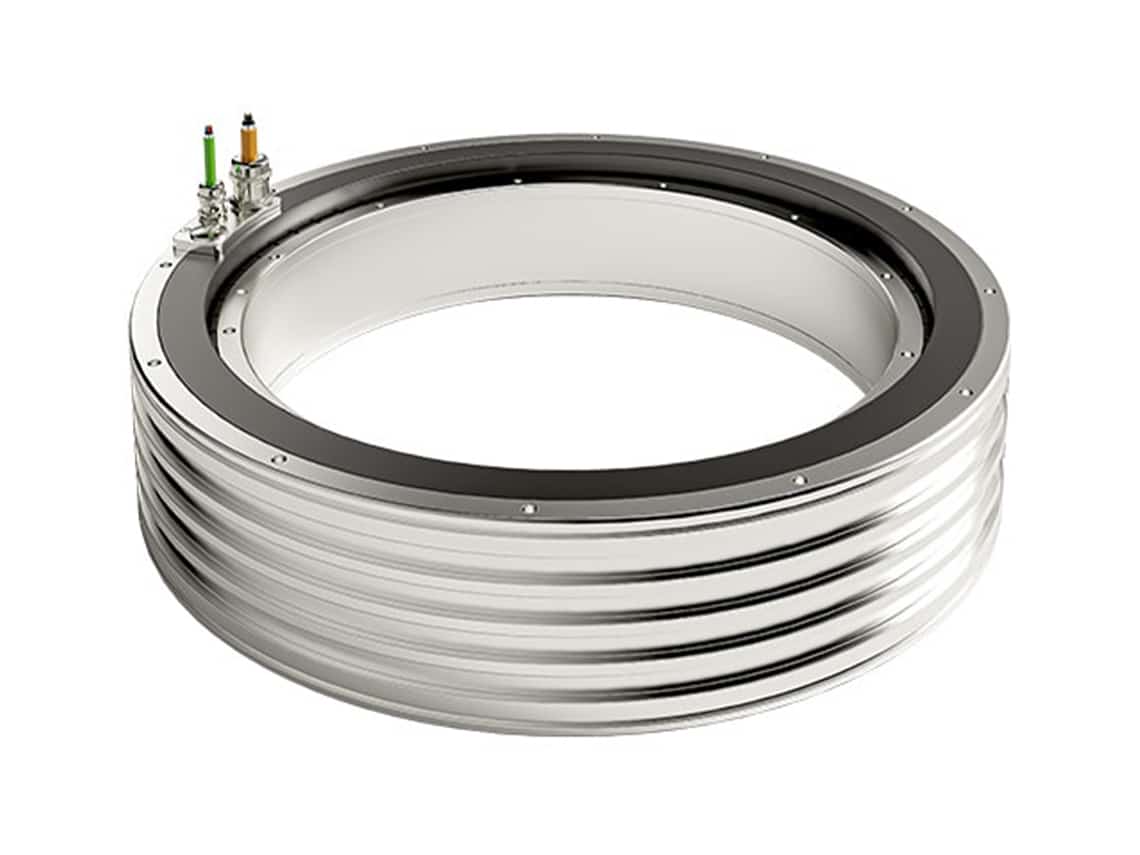


QTL-485 Series
With a large inner diameter, the QTL 385 is suitable for integration into (even existing) applications in various markets, such as rotary indexing tables, printing presses, and material handling.
It has an external cooling ring that must be enclosed in the machine structure (jacket) to form the channels for forced cooling.
More info at tecnotion.com
Attributes
Technical Specifications
- Peak torque: 1651 – 2202 Nm
- Continuous torque: 659 – 907 Nm
- Available heights: 485-85 / 485-105
Download
FAQ
It is the torque the motor can generate beyond the saturation point, in the non-linear region of the motor’s torque constant. In this condition, the effective value of the torque constant is 26% lower than the catalog value. This parameter applies only to torque motors. Since the efficiency of current-to-torque conversion decreases, the windings heat up more quickly. At ultimate torque, the temperature rise is 10 K/s or 20 K/s, depending on the motor series.
In iron core motors, peak torque is the torque generated immediately beyond the saturation point of the motor’s torque constant. In this condition, the effective value of the torque constant is 14% lower than the catalog value. The windings heat up at a rate of 6 or 20 K/s, depending on the motor series. Ironless motors, on the other hand, do not have a torque constant saturation point. In this case, peak torque is determined by the maximum allowable thermal expansion of the winding material. For these motors, the temperature rise is 20 K/s.
The motor constant is the ratio of torque generated (in newton-meters) to power dissipated as heat (in Watts), expressed in Nm²/W. A higher constant value indicates that the motor generates the same torque while dissipating less heat, making it more thermally efficient. The constant value decreases as winding temperature increases, due to the rise in phase-to-phase electrical resistance (Rph-ph).
Formula: S = K² / (3 × Rph-ph)
The QTL and QTM series share the same core technology but are designed to meet different application requirements. The QTM series was developed specifically for the machine tool sector. Compared to the QTL series, it offers performance optimized for this type of application, particularly in terms of operating speeds, making it ideal for machining processes requiring high dynamics and productivity. The QTL series, on the other hand, is a more versatile solution, suited to a wide range of industrial applications where the specific characteristics of the machine tool sector are not required.
Request information